


Golang map 实现原理
1. 基本用法
1.1 概述
map 又称字典,是一种常用的数据结构,核心特征包含下述三点:
(1)存储基于 key-value 对映射的模式;
(2)基于 key 维度实现存储数据的去重;
(3)读、写、删操作控制,时间复杂度 .
1.2 初始化
1.2.1 几种初始化方法
golang 中,对 map 的初始化分为以下几种方式:
myMap1 := make(map[int]int,2)通过 make 关键字进行初始化,同时指定 map 预分配的容量.
myMap2 := make(map[int]int)通过 make 关键字进行初始化,不显式声明容量,因此默认容量 为 0.
myMap3 :=map[int]int{ 1:2, 3:4,}初始化操作连带赋值,一气呵成.
1.2.2 key 的类型要求
map 中,key 的数据类型必须为可比较的类型,chan、map、func不可比较
1.3 读
读 map 分为下面两种方式:
v1 := myMap[10]第一种方式是直接读,倘若 key 存在,则获取到对应的 val,倘若 key 不存在或者 map 未初始化,会返回 val 类型的零值作为兜底.
v2,ok := myMap[10]第二种方式是读的同时添加一个 bool 类型的 flag 标识是否读取成功. 倘若 ok == false,说明读取失败, key 不存在,或者 map 未初始化.
此处同一种语法能够实现不同返回值类型的适配,是由于代码在汇编时,会根据返回参数类型的区别,映射到不同的实现方法.
1.4 写
myMap[5] = 6写操作的语法如上. 须注意的一点是,倘若 map 未初始化,直接执行写操作会导致 panic:
const plainError stringpanic(plainError("assignment to entry in nil map"))1.5 删
delete(myMap,5)执行 delete 方法时,倘若 key 存在,则会从 map 中将对应的 key-value 对删除;倘若 key 不存在或 map 未初始化,则方法直接结束,不会产生显式提示.
1.6 遍历
遍历分为下面两种方式:
for k,v := range myMap{ // ...}基于 k,v 依次承接 map 中的 key-value 对;
for k := range myMap{ // ...}基于 k 依次承接 map 中的 key,不关注 val 的取值.
需要注意的是,在执行 map 遍历操作时,获取的 key-value 对并没有一个固定的顺序,因此前后两次遍历顺序可能存在差异.
1.7 并发冲突
map 不是并发安全的数据结构,倘若存在并发读写行为,会抛出 fatal error.
具体规则是:
(1)并发读没有问题;
(2)并发读写中的”写”是广义上的,包含写入、更新、删除等操作;
(3)读的时候发现其他 goroutine 在并发写,抛出 fatal error;
(4)写的时候发现其他 goroutine 在并发写,抛出 fatal error.
fatal("concurrent map read and map write")fatal("concurrent map writes")需要关注,此处并发读写会引发 fatal error,是一种比 panic 更严重的错误,无法使用 recover 操作捕获.
2. 核心原理
map 又称为 hash map,在算法上基于 hash 实现 key 的映射和寻址;在数据结构上基于桶数组实现 key-value 对的存储.
以一组 key-value 对写入 map 的流程为例进行简述:
(1)通过哈希方法取得 key 的 hash 值;
(2)hash 值对桶数组长度取模,确定其所属的桶;
(3)在桶中插入 key-value 对.
hash 的性质,保证了相同的 key 必然产生相同的 hash 值,因此能映射到相同的桶中,通过桶内遍历的方式锁定对应的 key-value 对.
因此,只要在宏观流程上,控制每个桶中 key-value 对的数量,就能保证 map 的几项操作都限制为常数级别的时间复杂度.
2.1 hash
hash 译作散列,是一种将任意长度的输入压缩到某一固定长度的输出摘要的过程,由于这种转换属于压缩映射,输入空间远大于输出空间,因此不同输入可能会映射成相同的输出结果. 此外,hash在压缩过程中会存在部分信息的遗失,因此这种映射关系具有不可逆的特质.
(1)hash 的可重入性:相同的 key,必然产生相同的 hash 值;
(2)hash 的离散性:只要两个 key 不相同,不论其相似度的高低,产生的 hash 值会在整个输出域内均匀地离散化;
(3)hash 的单向性:企图通过 hash 值反向映射回 key 是无迹可寻的.
(4)hash 冲突:由于输入域(key)无穷大,输出域(hash 值)有限,因此必然存在不同 key 映射到相同 hash 值的情况,称之为 hash 冲突.
2.2 桶数组
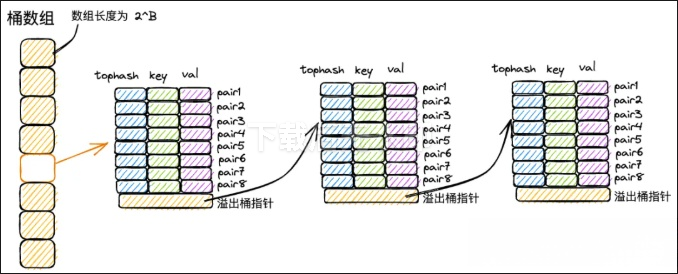
map 中,会通过长度为 2 的整数次幂的桶数组进行 key-value 对的存储:
(1)每个桶固定可以存放 8 个 key-value 对;
(2)倘若超过 8 个 key-value 对打到桶数组的同一个索引当中,此时会通过创建桶链表的方式来化解这一问题.
2.3 拉链法解决 hash 冲突
首先,由于 hash 冲突的存在,不同 key 可能存在相同的 hash 值;
再者,hash 值会对桶数组长度取模,因此不同 hash 值可能被打到同一个桶中.
综上,不同的 key-value 可能被映射到 map 的同一个桶当中.
此时最经典的解决手段分为两种:拉链法和开放寻址法.
(1)拉链法
拉链法中,将命中同一个桶的元素通过链表的形式进行链接,因此很便于动态扩展.
(2)开放寻址法
开放寻址法中,在插入新条目时,会基于一定的探测策略持续寻找,直到找到一个可用于存放数据的空位为止.
对标拉链还有开放寻址法,两者的优劣对比:
| 方法 | 优点 |
|---|---|
| 拉链法 | 简单常用;无需预先为元素分配内存. |
| 开放寻址法 | 无需额外的指针用于链接元素;内存地址完全连续,可以基于局部性原理,充分利用 CPU 高速缓存. |
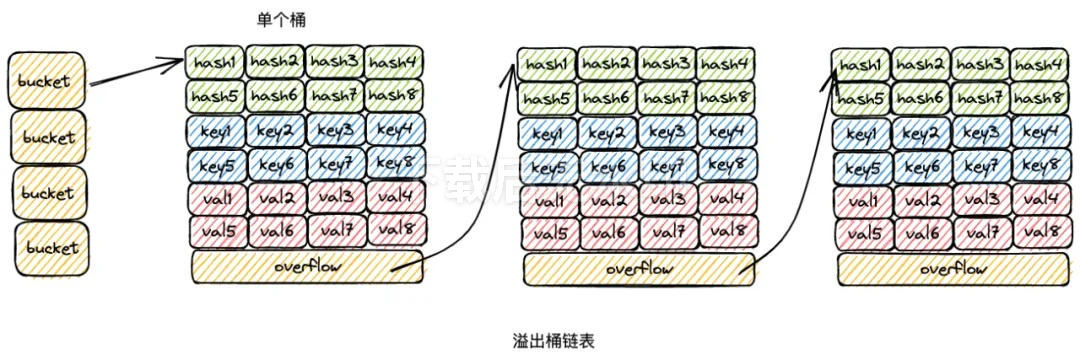
在 map 解决 hash /分桶 冲突问题时,实际上结合了拉链法和开放寻址法两种思路. 以 map 的插入写流程为例,进行思路阐述:
(1)桶数组中的每个桶,严格意义上是一个单向桶链表,以桶为节点进行串联;
(2)每个桶固定可以存放 8 个 key-value 对;
(3)当 key 命中一个桶时,首先根据开放寻址法,在桶的 8 个位置中寻找空位进行插入;
(4)倘若桶的 8 个位置都已被占满,则基于桶的溢出桶指针,找到下一个桶,重复第(3)步;
(5)倘若遍历到链表尾部,仍未找到空位,则基于拉链法,在桶链表尾部续接新桶,并插入 key-value 对.
2.4 扩容优化性能
倘若 map 的桶数组长度固定不变,那么随着 key-value 对数量的增长,当一个桶下挂载的 key-value 达到一定的量级,此时操作的时间复杂度会趋于线性,无法满足诉求.
因此在实现上,map 桶数组的长度会随着 key-value 对数量的变化而实时调整,以保证每个桶内的 key-value 对数量始终控制在常量级别,满足各项操作为 O(1) 时间复杂度的要求.
map 扩容机制的核心点包括:
(1)扩容分为增量扩容和等量扩容;
(2)当桶内 key-value 总数/桶数组长度 > 6.5 时发生增量扩容,桶数组长度增长为原值的两倍;
(3)当桶内溢出桶数量大于等于 2^B 时( B 为桶数组长度的指数,B 最大取 15),发生等量扩容,桶的长度保持为原值;
(4)采用渐进扩容的方式,当桶被实际操作到时,由使用者负责完成数据迁移,避免因为一次性的全量数据迁移引发性能抖动.
3. 数据结构
3.1 hmap
type hmap struct { count int flags uint8 B uint8 noverflow uint16 hash0 uint32 buckets unsafe.Pointer oldbuckets unsafe.Pointer nevacuate uintptr extra *mapextra}(1)count:map 中的 key-value 总数;
(2)flags:map 状态标识,可以标识出 map 是否被 goroutine 并发读写;
(3)B:桶数组长度的指数,桶数组长度为 2^B;
(4)noverflow:map 中溢出桶的数量;
(5)hash0:hash 随机因子,生成 key 的 hash 值时会使用到;
(6)buckets:桶数组;
(7)oldbuckets:扩容过程中老的桶数组;
(8)nevacuate:扩容时的进度标识,index 小于 nevacuate 的桶都已经由老桶转移到新桶中;
(9)extra:预申请的溢出桶.
3.2 mapextra
type mapextra struct { overflow *[]*bmap oldoverflow *[]*bmap nextOverflow *bmap}在 map 初始化时,倘若容量过大,会提前申请好一批溢出桶,以供后续使用,这部分溢出桶存放在 hmap.mapextra 当中:
(1)mapextra.overflow:供桶数组 buckets 使用的溢出桶;
(2)mapextra.oldoverFlow: 扩容流程中,供老桶数组 oldBuckets 使用的溢出桶;
(3)mapextra.nextOverflow:下一个可用的溢出桶.
3.3 bmap
const bucketCnt = 8type bmap struct { tophash [bucketCnt]uint8}(1)bmap 就是 map 中的桶,可以存储 8 组 key-value 对的数据,以及一个指向下一个溢出桶的指针;
(2)每组 key-value 对数据包含 key 高 8 位 hash 值 tophash,key 和 val 三部分;
(3)在代码层面只展示了 tophash 部分,但由于 tophash、key 和 val 的数据长度固定,因此可以通过内存地址偏移的方式寻找到后续的 key 数组、val 数组以及溢出桶指针;
(4)为方便理解,把完整的 bmap 类声明代码补充如下:
type bmap struct { tophash [bucketCnt]uint8 keys [bucketCnt]T values [bucketCnt]T overflow uint8}4. 构造方法
创建 map 时,实际上会调用 runtime/map.go 文件中的 makemap 方法,下面对源码展开分析:
4.1 makemap
方法主干源码一览:
func makemap(t *maptype, hint int, h *hmap) *hmap { mem, overflow := math.MulUintptr(uintptr(hint), t.bucket.size) if overflow || mem > maxAlloc { hint = 0 }
if h == nil { h = new(hmap) } h.hash0 = fastrand()
B := uint8(0) for overLoadFactor(hint, B) { B++ } h.B = B
if h.B != 0 { var nextOverflow *bmap h.buckets, nextOverflow = makeBucketArray(t, h.B, nil) if nextOverflow != nil { h.extra = new(mapextra) h.extra.nextOverflow = nextOverflow } }
return h}(1)hint 为 map 拟分配的容量;在分配前,会提前对拟分配的内存大小进行判断,倘若超限,会将 hint 置为零;
mem, overflow := math.MulUintptr(uintptr(hint), t.bucket.size)if overflow || mem > maxAlloc { hint = 0}(2)通过 new 方法初始化 hmap;
if h == nil { h = new(hmap)}(3)调用 fastrand,构造 hash 因子:hmap.hash0;
h.hash0 = fastrand()```
(4)大致上基于 log2(B) >= hint 的思路(具体见 4.2 小节 overLoadFactor 方法的介绍),计算桶数组的容量 B;
```goB := uint8(0)for overLoadFactor(hint, B) { B++}h.B = B(5)调用 makeBucketArray 方法,初始化桶数组 hmap.buckets;
var nextOverflow *bmaph.buckets, nextOverflow = makeBucketArray(t, h.B, nil)(6)倘若 map 容量较大,会提前申请一批溢出桶 hmap.extra.
if nextOverflow != nil { h.extra = new(mapextra) h.extra.nextOverflow = nextOverflow}4.2 overLoadFactor
通过 overLoadFactor 方法,对 map 预分配容量和桶数组长度指数进行判断,决定是否仍需要增长 B 的数值:
const loadFactorNum = 13const loadFactorDen = 2const goarch.PtrSize = 8const bucketCnt = 8
func overLoadFactor(count int, B uint8) bool { return count > bucketCnt && uintptr(count) > loadFactorNum*(bucketShift(B)/loadFactorDen)}
func bucketShift(b uint8) uintptr { return uintptr(1) << (b & (goarch.PtrSize*8 - 1))}(1)倘若 map 预分配容量小于等于 8,B 取 0,桶的个数为 1;
(2)保证 map 预分配容量小于等于桶数组长度 * 6.5.
4.3 makeBucketArray
makeBucketArray 方法会进行桶数组的初始化,并根据桶的数量决定是否需要提前作溢出桶的初始化. 方法主干代码如下:
func makeBucketArray(t *maptype, b uint8, dirtyalloc unsafe.Pointer) (buckets unsafe.Pointer, nextOverflow *bmap) { base := bucketShift(b) nbuckets := base if b >= 4 { nbuckets += bucketShift(b - 4) }
buckets = newarray(t.bucket, int(nbuckets))
if base != nbuckets { nextOverflow = (*bmap)(add(buckets, base*uintptr(t.bucketsize))) last := (*bmap)(add(buckets, (nbuckets-1)*uintptr(t.bucketsize))) last.setoverflow(t, (*bmap)(buckets)) } return buckets, nextOverflow}makeBucketArray 会为 map 的桶数组申请内存,在桶数组的指数 b >= 4时(桶数组的容量 >= 52 ),会需要提前创建溢出桶。
通过 base 记录桶数组的长度,不包含溢出桶;通过 nbuckets 记录累加上溢出桶后,桶数组的总长度.
5. 读流程
5.1 读流程梳理
map 读流程主要分为以下几步:
(1)根据 key 取 hash 值;
(2)根据 hash 值对桶数组取模,确定所在的桶;
(3)沿着桶链表依次遍历各个桶内的 key-value 对;
(4)命中相同的 key,则返回 value;若 key 不存在,则返回零值.
map 读操作最终会走进 runtime/map.go 的 mapaccess 方法中,下面是关键实现和说明:
5.2 mapaccess 方法(关键代码)
func mapaccess1(t *maptype, h *hmap, key unsafe.Pointer) unsafe.Pointer { if h == nil || h.count == 0 { return unsafe.Pointer(&zeroVal[0]) } if h.flags&hashWriting != 0 { fatal("concurrent map read and map write") } hash := t.hasher(key, uintptr(h.hash0)) m := bucketMask(h.B) b := (*bmap)(add(h.buckets, (hash&m)*uintptr(t.bucketsize))) if c := h.oldbuckets; c != nil { if !h.sameSizeGrow() { m >>= 1 } oldb := (*bmap)(add(c, (hash&m)*uintptr(t.bucketsize))) if !evacuated(oldb) { b = oldb } } top := tophash(hash)bucketloop: for ; b != nil; b = b.overflow(t) { for i := uintptr(0); i < bucketCnt; i++ { if b.tophash[i] != top { if b.tophash[i] == emptyRest { break bucketloop } continue } k := add(unsafe.Pointer(b), dataOffset+i*uintptr(t.keysize)) if t.indirectkey() { k = *((*unsafe.Pointer)(k)) } if t.key.equal(key, k) { e := add(unsafe.Pointer(b), dataOffset+bucketCnt*uintptr(t.keysize)+i*uintptr(t.elemsize)) if t.indirectelem() { e = *((*unsafe.Pointer)(e)) } return e } } } return unsafe.Pointer(&zeroVal[0])}关键说明(简要):
- 未初始化或空 map:直接返回零值指针;
- 并发写检测:若发现写标记(hashWriting),抛出 fatal;
- 扩容兼容:若处于扩容(oldbuckets != nil),可能需要先在 oldbuckets 中取桶并判断是否已迁移;
- 使用 tophash(hash 的高 8 位,且避开 0-4 的保留值)进行快速筛选,匹配后再比较完整 key。
6. 写流程
6.1 写流程梳理
map 写流程主要分为:
- 根据 key 取 hash 值;
- 根据 hash 值计算桶索引;
- 若处于扩容,帮助迁移命中的桶(渐进扩容);
- 遍历桶链表查找匹配或空槽;
- 若已存在 key,则更新 value;否则插入;
- 若触发扩容条件,则开启扩容并重试定位。
6.2 mapassign(关键代码)
func mapassign(t *maptype, h *hmap, key unsafe.Pointer) unsafe.Pointer { if h == nil { panic(plainError("assignment to entry in nil map")) } if h.flags&hashWriting != 0 { fatal("concurrent map writes") } hash := t.hasher(key, uintptr(h.hash0))
h.flags ^= hashWriting
if h.buckets == nil { h.buckets = newobject(t.bucket) }
again: bucket := hash & bucketMask(h.B) if h.growing() { growWork(t, h, bucket) } b := (*bmap)(add(h.buckets, bucket*uintptr(t.bucketsize))) top := tophash(hash)
var inserti *uint8 var insertk unsafe.Pointer var elem unsafe.Pointerbucketloop: for { for i := uintptr(0); i < bucketCnt; i++ { if b.tophash[i] != top { if isEmpty(b.tophash[i]) && inserti == nil { inserti = &b.tophash[i] insertk = add(unsafe.Pointer(b), dataOffset+i*uintptr(t.keysize)) elem = add(unsafe.Pointer(b), dataOffset+bucketCnt*uintptr(t.keysize)+i*uintptr(t.elemsize)) } if b.tophash[i] == emptyRest { break bucketloop } continue } k := add(unsafe.Pointer(b), dataOffset+i*uintptr(t.keysize)) if t.indirectkey() { k = *((*unsafe.Pointer)(k)) } if !t.key.equal(key, k) { continue } if t.needkeyupdate() { typedmemmove(t.key, k, key) } elem = add(unsafe.Pointer(b), dataOffset+bucketCnt*uintptr(t.keysize)+i*uintptr(t.elemsize)) goto done } ovf := b.overflow(t) if ovf == nil { break } b = ovf }
if !h.growing() && (overLoadFactor(h.count+1, h.B) || tooManyOverflowBuckets(h.noverflow, h.B)) { hashGrow(t, h) goto again }
if inserti == nil { newb := h.newoverflow(t, b) inserti = &newb.tophash[0] insertk = add(unsafe.Pointer(newb), dataOffset) elem = add(insertk, bucketCnt*uintptr(t.keysize)) }
if t.indirectkey() { kmem := newobject(t.key) *(*unsafe.Pointer)(insertk) = kmem insertk = kmem } if t.indirectelem() { vmem := newobject(t.elem) *(*unsafe.Pointer)(elem) = vmem } typedmemmove(t.key, insertk, key) *inserti = top h.count++
done: if h.flags&hashWriting == 0 { fatal("concurrent map writes") } h.flags &^= hashWriting if t.indirectelem() { elem = *((*unsafe.Pointer)(elem)) } return elem}要点:
- 对未初始化的 map 进行写会 panic;
- 写前设置写标记(hashWriting),写后清除;
- 在插入前会检查是否需要触发扩容;
- 插入时优先复用第一个空槽(inserti),否则新建溢出桶。
7. 删除流程
7.1 删除流程梳理
删除流程与读、写类似:先定位桶,再遍历链表;命中后清除 key、value,并更新 tophash 与相邻空位标记,必要时帮助扩容迁移。
7.2 mapdelete(关键代码)
func mapdelete(t *maptype, h *hmap, key unsafe.Pointer) { if h == nil || h.count == 0 { return } if h.flags&hashWriting != 0 { fatal("concurrent map writes") }
hash := t.hasher(key, uintptr(h.hash0))
h.flags ^= hashWriting
bucket := hash & bucketMask(h.B) if h.growing() { growWork(t, h, bucket) } b := (*bmap)(add(h.buckets, bucket*uintptr(t.bucketsize))) bOrig := b top := tophash(hash)search: for ; b != nil; b = b.overflow(t) { for i := uintptr(0); i < bucketCnt; i++ { if b.tophash[i] != top { if b.tophash[i] == emptyRest { break search } continue } k := add(unsafe.Pointer(b), dataOffset+i*uintptr(t.keysize)) k2 := k if t.indirectkey() { k2 = *((*unsafe.Pointer)(k2)) } if !t.key.equal(key, k2) { continue } // Only clear key if there are pointers in it. if t.indirectkey() { *(*unsafe.Pointer)(k) = nil } else if t.key.ptrdata != 0 { memclrHasPointers(k, t.key.size) } e := add(unsafe.Pointer(b), dataOffset+bucketCnt*uintptr(t.keysize)+i*uintptr(t.elemsize)) if t.indirectelem() { *(*unsafe.Pointer)(e) = nil } else if t.elem.ptrdata != 0 { memclrHasPointers(e, t.elem.size) } else { memclrNoHeapPointers(e, t.elem.size) } b.tophash[i] = emptyOne // 如果是末位或后续为空,则向前合并为 emptyRest if i == bucketCnt-1 { if b.overflow(t) != nil && b.overflow(t).tophash[0] != emptyRest { goto notLast } } else { if b.tophash[i+1] != emptyRest { goto notLast } } for { b.tophash[i] = emptyRest if i == 0 { if b == bOrig { break } c := b for b = bOrig; b.overflow(t) != c; b = b.overflow(t) { } i = bucketCnt - 1 } else { i-- } if b.tophash[i] != emptyOne { break } } notLast: h.count-- if h.count == 0 { h.hash0 = fastrand() } break search } }
if h.flags&hashWriting == 0 { fatal("concurrent map writes") } h.flags &^= hashWriting}8. 遍历流程
map 的遍历首先创建迭代器(hiter),随机选择起始桶与起始偏移,然后通过 mapiternext 实现按顺序遍历(兼容扩容场景)。
8.1 迭代器结构(hiter)
type hiter struct { key unsafe.Pointer elem unsafe.Pointer t *maptype h *hmap buckets unsafe.Pointer bptr *bmap overflow *[]*bmap oldoverflow *[]*bmap startBucket uintptr offset uint8 wrapped bool B uint8 i uint8 bucket uintptr checkBucket uintptr}8.2 mapiterinit / mapiternext(要点)
- mapiterinit 初始化迭代器并随机选取 startBucket 与 offset;若 t.bucket.ptrdata == 0,会预取 overflow 信息供迭代器使用;
- mapiternext 在遍历时检测并发写(hashWriting),并在遇到扩容时通过 checkBucket 兼容旧桶未迁移的数据顺序;
- 遍历遇到被标记为 evacuated 的条目时,会通过 mapaccessK 等方法完成安全读取。
9. 扩容流程
9.1 扩容类型
- 增量扩容(grow bigger):桶数组长度翻倍;
- 等量扩容(same size grow):保持桶数量不变,但降低溢出桶数量,提高填充率。
9.2 何时扩容
- 只有写操作可能触发扩容;
- overLoadFactor 判断(count > bucketCnt 且 count > loadFactorNum*(bucketShift(B)/loadFactorDen))会触发增量扩容;
- tooManyOverflowBuckets 判断溢出桶过多会触发等量扩容。
相关常量与函数:
const loadFactorNum = 13const loadFactorDen = 2const bucketCnt = 8
func overLoadFactor(count int, B uint8) bool { return count > bucketCnt && uintptr(count) > loadFactorNum*(bucketShift(B)/loadFactorDen)}
func tooManyOverflowBuckets(noverflow uint16, B uint8) bool { if B > 15 { B = 15 } return noverflow >= uint16(1)<<(B&15)}9.3 开启扩容(hashGrow 要点)
- 根据 overLoadFactor 决定 bigger(0 或 1);
- 将旧 buckets 赋给 oldbuckets,创建新 buckets,并初始化 nevacuate 等字段;
- 如果存在预分配的 overflow,会把它们提升为 oldoverflow。
9.4 扩容迁移规则与渐进式迁移
- 在增量扩容中,旧桶中的条目要么迁到 x 区(同索引),要么迁到 y 区(索引 + oldBucketsLen),取决于 hash 的低位;
- map 采用渐进式扩容:每次写/删会迁移两组桶 —— 当前命中的桶与最小未迁移桶(h.nevacuate);
- evacuate 会遍历旧桶,把条目按规则搬到目标桶(并标记已搬迁),在适当时机释放旧桶引用。
文章分享
如果这篇文章对你有帮助,欢迎分享给更多人!